
The Imam, the Empress, and the City
The Satanic VersesThis flow traces Gibreel’s second visionary narrative, in which an exiled Imam imagines a revolution against history and an Empress embodies the power he seeks to defeat.
increasing Bearing strength in each event
 decreasing
Bearing strength in each eventdecreasingThe Exile’s Waiting Room

The Exile’s Waiting Room
A homeland reduced to an image
Gibreel dreams of an exiled Imam living in Kensington, where closed curtains and bodyguards are meant to keep foreignness at a distance. The Imam treats London as a waiting room and insists that the real homeland remains untouched in memory, even as his life depends on the city that shelters him.
The Empress as adversary
A portrait of Empress Ayesha hangs in the Imam’s bedroom. She represents the political order that expelled him, but also an opposing vision of time, power, and worldly life. Their intimacy as enemies is expressed through the portraits they keep of one another: each remains close to the person whose rule they seek to destroy.
The exile’s purity is inseparable from his desire for return. His refusal to be changed by London gives him a sense of purpose, but also traps him in a past that he wants to restore without alteration.
A Revolution Against History

A Revolution Against History
The voice travels farther than the body
The Imam’s message reaches Desh through radio transmissions voiced by Bilal X. He calls for a revolution not only against the Empress but against history itself, treating memory, progress, science, and political change as corruptions of a completed sacred order.
Water against wine
The Imam describes himself as water: pure, still, and life-preserving. He casts the Empress as wine and blood, bound to appetite and the passage of time. His rhetoric turns personal exile into a political program, promising a return to timelessness in which clocks and birthdays will no longer govern human life.
The appeal of the message lies partly in its promise to abolish uncertainty. Yet the same desire for purity makes the Imam hostile to pluralism and dissent. The revolution’s language of liberation contains an authoritarian demand that history, difference, and change be eliminated.
The People at the Palace Gates
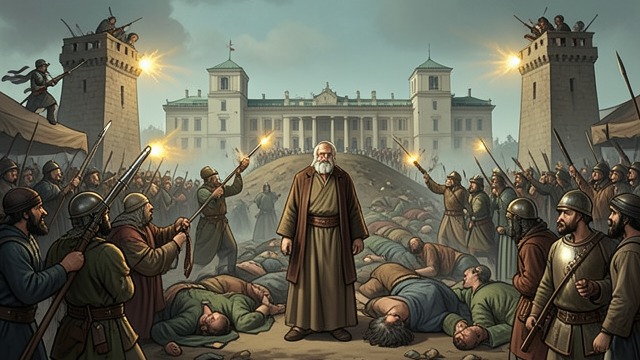
The People at the Palace Gates
A march into gunfire
The Imam asks Gibreel to carry him to Jerusalem, which becomes an idea of political victory as much as a destination. In the vision, crowds move toward the Empress’s palace while her guards fire on them. The dead form a rising hill, and the Imam interprets the people’s sacrifice as proof of their love.
The revolution consumes its promise
Gibreel objects that the march is driven by hatred and repression, not love. The Imam insists that the people long for a still, eternal order beyond the Empress’s clocks and the anxieties of aging. Once the crowd overwhelms the guards, the palace appears to fall and Al-Lat rises from it as a winged adversary.
Gibreel fights Al-Lat under the Imam’s command, and she falls. But the apparent victory reveals the danger of the Imam’s triumph: he swallows the people entering the palace, absorbing them into his power. The revolution that promised freedom from history becomes another force that consumes those who make it.
A Mission Recast as Judgment

A Mission Recast as Judgment
London becomes a spiritual map
After the Imam dream, Gibreel interprets London through the imagined eyes of an angel. The city’s buildings and inhabitants seem to reveal hidden moral essences, while his street atlas promises a route through a place he believes he has been sent to redeem.
The certainty fails
Gibreel tries to make his presence known, but Londoners ignore him. His sense of divine authority cannot compel them to listen, and his effort to help Orphia Phillips even disrupts the life he meant to repair. The episode exposes the difference between reading other people’s desires and understanding what will actually serve them.
His conviction rises and falls with his illness. He alternates between seeing himself as the agent of God’s will and fearing that his mission is a product of delusion. The city remains resistant to a single moral interpretation, and Gibreel’s desire for clear divisions becomes another source of torment.
The Horn as a Final Choice
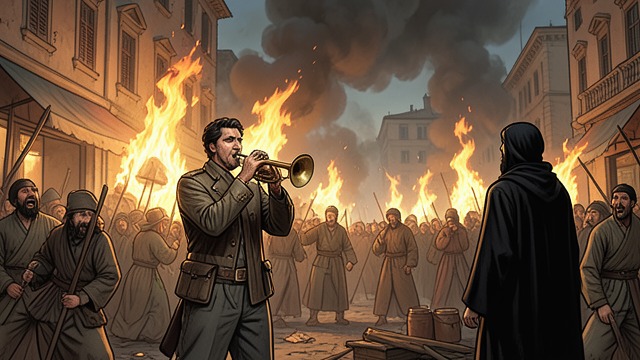
The Horn as a Final Choice
From revelation to action
Gibreel wanders through London with the trumpet Azraeel, moving through overlapping visions of Jahilia, the pilgrimage, and the city’s unrest. When he encounters exploited girls on the Goodsway, he hears their need and acts against the pimps who control them, using the horn’s destructive power.
Judgment without certainty
At Brickhall, Gibreel sees a city full of anger, fear, and desire. He treats the fires as a judgment that grants people what they want and consumes them by it, even as the real violence remains political and communal. His actions blur the distinction between rescue and punishment.
In the burning Shaandaar, Gibreel recognizes that Saladin’s voice and conduct have been the source of the calls that destroyed his trust in Alleluia. He reaches the man he sees as the adversary, but chooses to save him from the fire. That choice briefly interrupts the logic of vengeance; it cannot, however, restore Gibreel’s stability or undo the deaths that follow.
After Gibreel’s arrival in London, as the Imam’s dream first appears
During the Imam’s broadcasts to Desh from London
In Gibreel’s vision of the revolution in Desh
After Gibreel’s visions turn toward his mission to redeem London
During the Brickhall unrest, shortly before Gibreel’s death
